Sunday, June 27, 2010

PWNED!

The local paper neglected to announce it until the last minute, but the PWNED! Youth Chess Tournament at the Freeport Public Library drew 15 participants, with the greatest turnout in the grade 4–6 section. Because of low numbers, the grade K–3 and 7–12 were changed from four-round Swiss to double round robin. (See event pictures on our photo page, crosstables on our tournament results page.) Winners were:

K–3
1st place: Dominick Welte (Roscoe)
2nd place: Darius Lewers (Freeport)
3rd place: Faith Hunter (Mount Carroll)

4–6
1st place: Hayden Keltner (Pearl City)
2nd place: Kirkland Shun (Rockford)
3rd place: McKinley Torre (Rockford)

7–12
1st place: Nathanael Kozinski (DeKalb)
2nd place: Yesenia Meraz (Rockford)
3rd place: John Werkheiser (Pearl City)

Yesenia generously shared her record of her second game with Nathanael.

Y.Meraz–N.Kozinski
PWNED! Youth Chess Tournament
Freeport, Ill., June 26, 2010

1.e4 e5 2.Nc3 Nf6 3.Nf3 Nc6 4.d4
Transposing into a Scotch Game.

4...exd4 5.Nxd4 Nxd4?
Trading knights leaves black at a disadvantage, with poor development.

6.Qxd4 b6 7.e5!
Yesenia presses forward aggressively.

7...Bb4??
With the queen on d4, Nathanael's bishop is defenseless.

8.Qd3
Aggressive just a moment before, Yesenia unexpectedly pulls back and settles for equality.

8...Ng8
Nathanael has a crafty move in 8...Qe7!?, saving his knight by pinning the e-pawn.

9.Be2
Nathanael's g-pawn is a soft patch in his side's armor; 9.Qg3! threatens 10.Qxg7 and a potent fork, while allowing Yesenia to answer 9...Bxc3+ with 10.Qxc3.

9...d6??
Opens the door to 10.Qb5+, gaining time to pick off the bishop (11.Qxb4). Might as well play 9...Ne7 immediately.

10.0-0 Ne7
In light of the Qb5+ threat, Nathanael should back up his bishop with 10...a5.

11.Qxd6?!
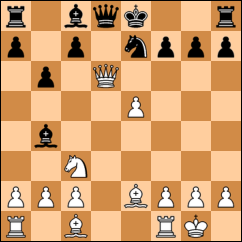

Wow! Yesenia seems to be throwing away her queen -- for what? Well, Nathanael offers an answer:

11...Qxd6
11...cxd6 is clearly the way to go.

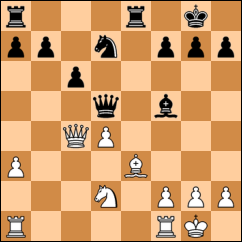
At this point, there appears to be a move missing on the transcript. I've interpolated 12.exd6 Bxd6 to make possible the subsequent positions played.

13.Re1 0-0 14.Bf3 c6 15.g3
15.Nb5! is an audacious move that exploits the bishop pin on black's c-pawn and threatens to capture the bishop on d6. Then 15...Bc5 16.Bg5 takes aim at the knight that guards the pawn.

15...Bf5 16.Be4 Rfe8 17.Bxf5 Nxf5
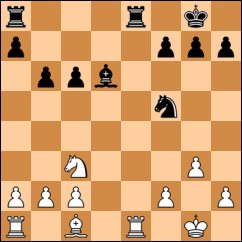

The scales are tipping in Nathanael's favor now.

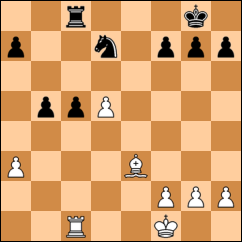
18.Rxe8+ Rxe8 19.a4
Nathanael is threatening 19...Re1+, followed by ...Nd4 and ...Nxc2. Yesenia needs to get her bishop out of the way so that she can defend that c-pawn. With material even, 19.Bf4!? Bxf4 20.gxf4 is tolerable.

19...Re1+
Whoomp! There it is!

20.Kg2 Nd4 21.Bd2??
Losing the c-pawn isn't a great prospect, but losing the remaining rook is worse.

21...Rxa1 22.Ne4 Rd1 23.Nxd6 Rxd2 24.c3 Ne6 25.Nf5 Rxb2 26.Ne7+
Using the check to slingshot over and grab a pawn.

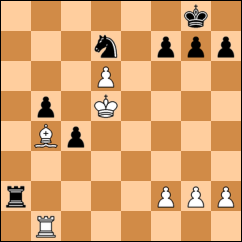
26...Kf8 27.Nxc6 a6 28.a5 b5! 29.h4 Rc2 30.Nb4 Rxc3 31.Nxa6 Ra3 32.f4 Rxa5 33.f5?
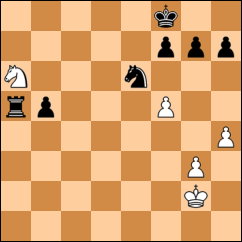

Trading knights is just too good a prospect for black. If 33...Rxa6 34.fxe6, black can simply make a dash for the first rank with 34...b4!, and white has no way of stopping him. 35.fxg7 goes nowhere as long as black's king sits tight on the pawn's promotion square. If 34.Kf3, on the other hand, black can ruin white's day with 34...b4 35.Ke2 Ra2+!!.

33...Nd4
Overlooking the power of the trade. But really, with a material advantage of a rook and a pawn, Nathanael has no grounds for complaining about his position.

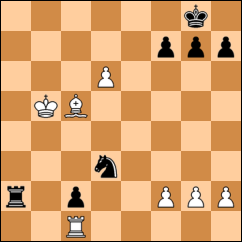
34.Nc5 b4 35.Nd3 b3 36.f6 gxf6 37.h5 Ra2+ 38.Kh3
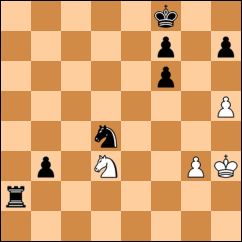

At this point, the transcript offers the move 37...g4+, which is both inscrutable and impossible. But equally impossible is white's position, and in fact, the game ends just a few moves later.

Thanks and congratulations to all our participants, and we hope to see all of you at future events.

Update/correction: Nathanael Kozinski confirms that his seventh move is 7...Bc5, not 7...Bb4. Also, the missing move sequence is 11.exd6 Qxd6 12.Qxd6 Bxd6.

Wednesday, June 16, 2010

Game of the Week

Gary Sargent and I were going over a game I blundered away at the Evanston Swiss Groups this weekend which began with a French Exchange. Afterward, Gary reset the board and played 1.e4 e6 2.d4 d5 3.exd5 exd5 himself, then followed up with 4.Be3. I took the hint.

G.Sargent–K.Ammann
Route 20 Chess Club
Freeport, Illinois, June 15, 2010

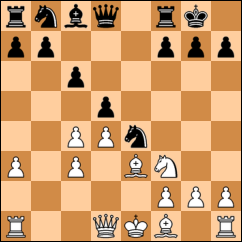
1.e4 e6 2.d4 d5 3.exd5 exd5 4.Be3?
A non-book move upon which ChessBase looks dimly, giving white only a 42 percent chance of winning. Jacques Mieses apparently loved this line; he seems to have played it exclusively from 1889 to 1905. (Later in life, he switched to 4.Bd3.)

4...Nf6 5.c4 c6
Actually, my first move -- as I'm finding nothing at all to my liking -- is 5...c5. This is followed by 6.dxc5 Bxc5?? 7.Bxc5. I shake my head sheepishly, and we return to the position after 5.c4. (Fritz smacks its virtual forehead and tells me to just play 5...Bb4+, then castle.)

6.Nc3 Bb4 7.a3 Bxd3+
"I guess I shouldn't be writing checks I'm not going to cash," I say.

8.bxc3 0-0 9.Nf3 Ne4
I see the unprotected pawn on c3 and smell blood.


10.Qc1
The right idea, inaccurately executed. 10.Qc2, the best move in the position, gives white a slight advantage. 10.Qc1 gives Gary a nearly equal disadvantage.

10...Bf5 11.Be2 Nd7 12.0-0 Qa5 13.cxd5
After the game, Gary commented that he "lost a pawn there somewhere" but wasn't entirely sure where. According to Fritz, this is where. Gary's pawn capture threatens further damage to my pawn structure -- but my next move threatens a piece capture and an ugly fork, making it the more pressing issue. (As an alternative, 13.Nd2!?, vacating f3, gives white's e2-bishop a chance not only to slip out of the capture but to shut down the idea of the fork with 14.Bf3.)

13...Nxc3
Threatening the devastating 14...Nxe2+. 13...Qxc3?, in contrast, is a fiasco: 14.Nh4 Bg6 15.f3 Qxc1 16.Rfxc1 wins two pawns (or the bishop, if white foolishly plays 16...cxd5?, which also leaves white's c-rook an unimpeded path to the seventh rank), while 13...cxd5?! 14.c4 allows the knight outpost to be undermined, and after 13...Qxd5 14.c4 Qd6 15.Qb2, you can practically hear the black pieces whimper, "Please don't hurt me."

14.Qe1 Nxe2+ 15.Qxe2 Qxd5
The knight looks pinned, but the check proves that it isn't, giving my queen time to scoot out of the way -- and to finish the pawn transaction.

16.Nd2 Rfe8 17.Qc4


I've spotted another lovely tactic . . .

17...Qxc4 18.Nxc4 Bd3 19.Nd6
. . . and missed one of Gary's. Still, there's nothing bad in this for me: I'm up a pawn, and it's an even trade that ends with my rook controlling the open e-file.

19...Bxf1 20.Nxe8 Rxe8 21.Kxf1 b5
A stumble. I'm thinking that we're even on the kingside and that there's no obvious goal in the center, so I may as well press on the queenside, where I have a significant pawn advantage. But why operate on the flank when I'm stronger in the center as well? Plus, 22.Rb1 is no real headache, but 22.d5!? could be. Thus, 21...Nf6 is a useful preventive move. 21...b5, in contrast, just gives Gary a target; I still have an advantage, but it's no longer decisive.

22.Rc1 Rc8 23.d5 c5


My pawn majority is intact, and I'm holding onto my material, but now Gary has a passed pawn.

24.Rb1
A non-threat. My active pieces are both tied down guarding a stupid pawn, making this a fine moment for Gary to bring his king into the action with 24.Ke2.

24...a6 25.a4
This just invites me to slip past with 25...b4 . . .

25...Rb8
. . . but I guess I haven't gotten the invitation.

26.axb5 axb5 27.Bf4 Rb7 28.Ke2
Here he comes!

28...c4
Not the best idea available to me. 28...f5 gives the black king a shorter path to his diminutive nemesis.

29.Bd2 Nf6 30.d6 Nd7
The blockading move is wholly unnecessary.

31.Bb4 Ra7 32.Ke3
Gary's king is threatening to slip behind my advanced pawns and knock them out. Where did my advantage go?

32...Nb6 33.Kd4 Nd7 34.Kd5 Ra2


I'm not paying enough attention to that open e-file. Re1 presents the risk of a back-rank mate. The thing for me to do right now is to push an h-pawn and give my king room to breathe.

35.Bc5??
Gary can cause me all kinds of headaches with 35.Kc6! and 36.Kxb5. This move, on the other hand, allows me an opportunity to trade off that bothersome bishop with 35...Rd2+ 36.Kc6 Nxc5 37.Kxc5.

35...c3 36.Kc6
36.Rxb5 leaves nothing to chance, and 36...c2 37.Be3 keeps my c-pawn from promoting.

36...c2??
Allows intolerable pressure in the form of 37.Re1! Nf6 38.d7.

37.Rc1??
It must be getting toward the end of the night. At this point, I spot what I think is another clever tactic:

37...Ne5+ 38.Kxb5 Nd3??


This slick-looking triple fork is actually a blunder, as it allows 39.d7! Rb2+ 40.Ka5 Rb8 41.Rxc2 -- and now it's white who's ahead in material, his d-pawn a ticking time bomb that forces black to cower in the corner with 41...Ne5 42.Ba7 Rf8. Gary gets the first part of my punishment right, but not the second.

39.d7! Rb2+ 40.Kc6
Allowing my knight to throw himself on the bomb with 40...Ne5+ 41.Kc7 Nxd7 42.Kxd7.

40...Rb8
Committing my rook to stopping Gary's d-pawn from promoting is a terrible idea. 41.Bd6 Rd8, and it might as well be locked in a cage.

41.Kc7
A clumsy move that hangs the bishop and also allows white to neutralize the d-pawn with 41...Nxc5 42.Kxb8 Nxd7+. "Driving home, it occurred to me that given the back-rank threat, 41.Rxc2 instead of the immediate 41.Kc7 is probably sufficient for a draw," Gary says, but he's wrong -- 41.Rxc2 is probably sufficient for a win. After 41...Ne5+ 42.Kc7 (or 42.Kd6) 43.Nxd7 Kxd7, white is a bishop ahead in an otherwise symmetrical endgame.

41...Nxc1??
An incredible blunder, allowing the d-pawn to promote with threat of mate after 42.Kxb8 -- but what's even more incredible is that Gary misses this too.

42.d8Q+ Rxd8 43.Kxd8 Nd3 44.Be3


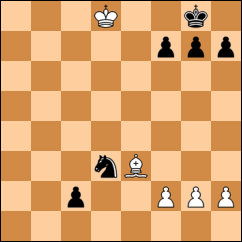
The threat from Gary's d-pawn gone, my own passed pawn miraculously alive, yet with Gary's bishop covering its promotion square, I proceed to end the game with one opportunistic move. What is it? (Highlight to reveal answer.)

44...Nxf2!? 0-1 If white takes the knight, the pawn will promote; therefore, 45.Ke7 Nd3, and white must part with his bishop on the promotion square, leaving black ahead by a knight and a pawn.

Wednesday, June 9, 2010

Game of the Week

G.Sargent–S.McWhirter
Route 20 Chess Club
Freeport, Illinois, June 8, 2010

1.d4 d5 2.c4 Nf6? 3.Nf3 e6 4.Bg5 Bb4? 5.a3 Bxc3+ 6.bxc3 0-0 7.Nf3 h6 8.Bh4 g5


9.Nxg5?!
Oddly aggressive, trading a piece for two pawns; there's some positional compensation, but probably not enough. 9.Bg3 is safe and sound.

9...hxg5 10.Bxg5 Kg7
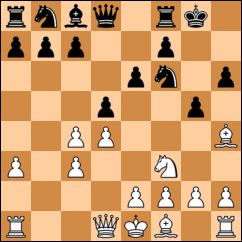
Why can't black play 10...dxc4? here (diagram)? (Highlight to reveal answer.)

11.e4 opens up a Pandora's box: 11...e5 12.Qf3 (not 12.Bxc4 Qd6) Nbd7 13.dxe5 Nxe5 14.Qxf6 Qxf6 15.Bxf6 Re8 and black is in disarray.

11.cxd5 Qxd5 12.Bxf6+ Kxf6 13.e3 Ke7 14.c4 Qa5+ 15.Qd2 Qxd2+ 16.Kxd2 Nc6 17.f4 b6 18.g3 Bb7 19.Rg1 Na5 20.Kc3 f5 21.h3 Be4


22.Bg2
A significant error. 22.g4!? is better.

22...Bxg2 23.Rxg2 Rh8 24.Rh1 Rac8 25.Rgg1?
25.g4 is still called for.

25...c5 26.Rc1 Rcg8
Steve should bust things open -- and pick up the pawns he's lost in the process -- with 26...cxd4+ 27.exd4 Rxc4+ 28.Kb2 Rxd4 29.Rh2.

27.Rcg1 Rd8 28.g4 fxg4 29.hxg4 cxd4+ 30.exd4 Rhf8 31.Rh7+ Rf7 32.Rxf7+ Kxf7 33.Re1


33...Nc6
33...Rc8 34.c5 bxc5 35.dxc5 Rxc5+ 36.Kb4 Nb7 claims a pawn and leaves white's king in a bad position.

34.f5??
Steve is threatening Gary's d-pawn; 34.Re4 or 34.Rd1 is a necessary protective move.

34...exf5 35.gxf5?
With Steve's e-pawn out of the way, Gary should consider 35.d5 Na5 36.Rf1.

35...Nxd4 36.Rd1


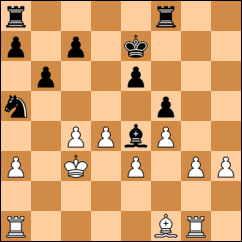
Time to end it. Black to play and win. (Highlight to reveal answer.)

36...Nb5+! 0-1
Gary resigns in light of 37.Kb4 Rxd1 38.cxb5 Kf6.