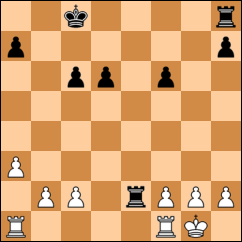
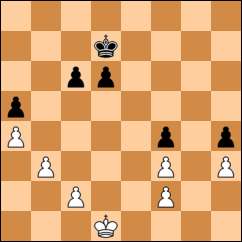
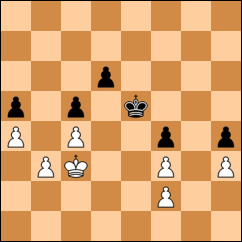
Wednesday, June 2, 2010

Game of the Week

K.Ammann–G.Sargent
Route 20 Chess Club
Freeport, Illinois, June 1, 2010

1.d4 d5 2.c4 e6 3.Nc3 Nf6 4.Nf3 h6
A nonstandard move; I guess Gary is trying to prevent 5.Bg5.

5.e3 Bb4 6.Qc2
Fritz wants me to play 6.Qa4+.

6...Ne4
This is a nuisance. I consider 7.Bd2, to break the pin, but decide instead to challenge the knight and prepare to castle.

7.Bd3 Nxc3 8.bxc3 dxc4 9.Bxc4 Bd6
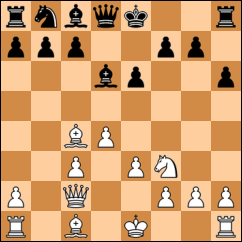


Now I'm thinking about how to develop my other bishop. Based on the shape of my pawn structure and the fact that the e-pawn is blocking it in, I'd like to put it on a3 . . .

10.a4 a5 11.Ba3 0-0 12.Bxd6
Trading off my bad bishop for Gary's good one and putting me nicely ahead in development.

12...cxd6 13.0-0 Nd7
My pawn structure points toward queenside play . . . hey, b5 looks like a perfect knight outpost! It's slow getting there, but I think I've got time.

14.Nd2 Nf6 15.f3
Stay back, horsey.

15...b6 16.Nb1 Ba6
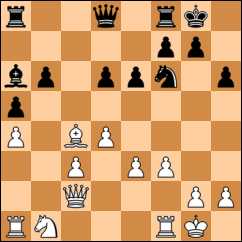


17.Na3
I like this move because it's the one I wanted to play anyway, and it also defends my bishop. But Fritz urges 17.Bxa6 Rxa6 18.c4 because of the threat of 17...Bxc4 18.Nxc4 Rc8 followed by 19...Nd5, piling on my backward pawn.

17...Qc7 18.Bxa6 Rxa6 19.Nb5 Qc6
Now I spend a lot of time trying to figure out which rook to put where. I wish I knew some kind of rule of thumb. Finally, I decide that some reinforcement is needed behind my c-pawn.

20.Rfc1 Nd5
Well, that's a pain. This move attacks both my backward pawns. Can I defend both of them? Yes.

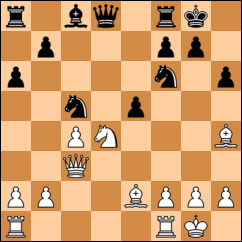
21.Qd3 Rc8?
Fritz points out that this move allows 22.Nxd6!? Rca8 (22...Qxd6 23.Qxa6) 23.Nb5.

22.e4 Nf4 23.Qd2 e5 24.d5 Qc4
With the threat of 25...Ne2+ 26.Kh1 (26.Qxe2 Qxe2) Nxc1 27.Qxc1. Better head that off immediately.

25.Rc2 Qd3?
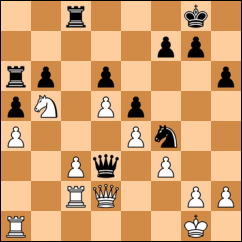


Unpleasant choice: 26...Rxc3 27.Rxc3 Qxd2 or 26...Rxc3 27.Qxc3 Qxc3 28.Rxc3 Ne2+. OK, that queen's got to go. And a beautiful bonus: After he retakes with the knight, I can knock out his backward d-pawn with initiative on his rook (which is why Fritz strongly prefers 25...Rd8).

26.Qxd3 Nxd3 27.Nxd6 Nb4??
Gary has one rook on a half-open file and another trapped in a cage. Also, I have way more space and an extra pawn. Oh, yeah -- I'm happy to trade.

28.Nxc8 Nxc2 29.Rb1
I miss a magnificent opportunity to sprint: 29.d6! Nxa1 30.d7 Ra8 31.d8Q+.

29...Ra8
You want to give me another pawn? OK.

30.Nxb6 Rb8
A pin. How do I get out of this with equality? First, I need to put the rook somewhere it's not hanging. At first, I consider the basic 31.Rb2 (which is in fact the best move), but then I get what I think is a cleverer idea. (It's not.)

31.Rb5 Na3 32.Nd7
I should send my rook back to b2 and let Gary trade away a rook for a knight if he wants to. I still have a decisive advantage after 32.Nd7, but much less of one.

32...Rxb5 33.axb5 Nxb5 34.c4
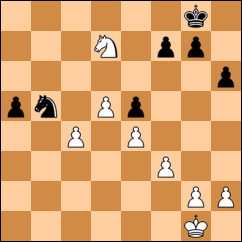


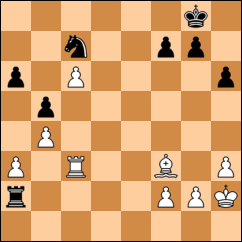
A psychologically amusing moment, as I suddenly "realize" that 34.c4 is a big mistake: 34...a4 35.b6 a3 36.Na4 a2 and 37...a1Q, which I can't stop, and I hope against hope that Gary doesn't see it.

Except that Gary does see . . . that he can't promote the pawn! The sequence he notices, which I'm missing, is 34...a4 35.Nc5 a3 36.Nb3.

34...Nd4?
Bad only because if 34...Nc3, his a-pawn can make a dash for the door, and while I can still stop it, I do so at the cost of my knight (35.Nxe5 -- hey, why not? -- a4 36.Nc6 a3 37.Nb4 a2 38.Nxa2 Nxa2).

35.Nb6
Thinking I've just had a narrow escape, I rush to blockade the little punk before it makes its break. I miss 35.Nxe5, which is a gimme.

35...f6 36.Na4 Kf7
Now that the "threat" of the passed a-pawn is put to rest, I feel good about this endgame. I'm going to get one of those two connected pawns to the finish line.

37.c5 Ke7
Gary's king can't get anywhere near those pawns, but I'm not going to be able to advance them any further unless I can do something about his knight.

38.Kf2 g6 39.g3 f5 40.f4 exf4 41.gxf4 (41.e5!) fxe4 42.Ke3 Nf3 43.Kxe4 (better is 43.h3 first) Nxh2
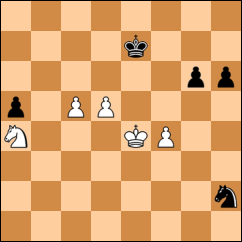


44.Ke5 (44.c6!! Kd6 45.Nc3 Ng4 46.Nb5+ Ke7 47.d6+ Ke6 48.c7 Kd7 49.Na7 is devastating) Nf3+
I have a brief moment of checkmate panic before I spot the escape square.

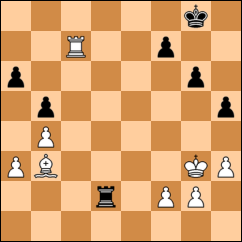
45.Ke4 Nd2+ 46.Kd3 Nb3 47.c6 Kd6 48.Kc4 Nd2+ 49.Kb5 h5
I count moves. Gary needs four free moves to promote his pawn. I need only one king move and two pawn moves.

50.Kb6
Adequate, but 50.Nc5 is a sure thing.

50...Nc4+ 51.Kb7 Kxd5
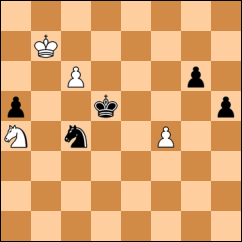


This concerns me, because now Gary can move Nd6 and take away my promotion square. Can I stop this from happening? Actually, I can, because as it happens, the placement of his pieces gives me a lovely fork.

52.Nb6+ Nxb6 53.Kxb6 h4 54.c7 h3 55.c8Q h2 56. Qh8 1-0

Thursday, May 27, 2010

Game of the Week

K.Ammann–J.Strong
Route 20 Chess Club
Freeport, Illinois, May 25, 2010

1.d4 d5 2.c4 e6 3.Nc3 a6?
A weak response, possibly intended to prepare ...b5 or prevent the utterly improbable Nb5. 3...c6 is the most solid response to the line, 3...Nf3 the most popular. 3...Be7 isn't unreasonable either.

4.e4
I'm looking to take advantage of Jim's failure to play 3...Nf3 or 3...c6, but more direct is 4.cxd5 exd5 5.Nf3 Nf6 6.Qb3.

4...dxe4 5.Nxe4 Nf6
There was also 5...Bb4+ to consider.

6.Bg5
I'm reluctant to trade, but 6.Nxf6 Qxf6 7.Nf3 is the only move.

6...Be7
Better is 6...Bb4+ 7.Nc3 c5.

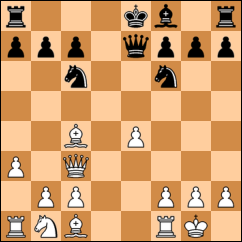
7.Qd3??
We're both stumbling through this offbeat QGD offshoot. With this queen move, I'm trying to defend my knight and my d-pawn simultaneously, but it doesn't really work: with 7...Nxe4! 8.Bxe7 Qxe7 9.Qxe4 Qb4+! 10.Kd1 Qxb2, my king is exposed, I can't castle anymore, I'm down a pawn, and I'm about to lose another. In light of this potential calamity, I'm still better off trading on f6: 7.Nxf6+ Bxf6 8.Bxf6 Qxf6.

7...Bb4+
Fortunately for me, Jim overlooks the threat too.

For the next dozen moves or so, it's more as though Jim is playing white and I'm playing black: he's trying to generate some kind of attack, and I'm batting his efforts aside, to his mounting frustration.

8.Nc3 Nbd7 9.Nf3 h6 10.Bh4 0-0 11.Be2 c5 12.0-0 cxd4 13.Nxd4
I miss a good opportunity here in 13.Qxd4 e5 14.Nxe5 Nxe5 15.Qxe5 Re8 16.Rad1, winning a pawn.

13...Nc5 14.Qe3 Bxc3 15.Qxc3
I could recapture with 15.bxc3 here. The doubled pawns aren't much of a problem -- they just give me the lovely b-file for one rook and d-file for the other.

15...e5


The game is going to be all about this pawn for a while.

16.Nf3 Re8 17.Rad1 Qe7 18.Bxf6 Qxf6 19.Rd5 Ne4
An aggressive "forward retreat," but 19...Nd7 is better: it both saves the knight and adds another defender to the e-pawn.

20.Qa5
There was nothing wrong with 20.Qe3 Bf5 21.Rfd1. With this move, I effectively give up my assault on the e-pawn. But I'm OK with that -- with his knight move, Jim has blockaded his own pawn's advance, so I needn't fear ...e4 threatening exf3 anymore. Still, my backing down gives Jim more freedom of movement.

20...b6 21.Qa3 Bg4 22.Rfd1 b5


Jim's threat is not ...b4 but ...bxc4. I can't resist.

23.c5
Perhaps I should have resisted, though, since 23.cxb5 is actually better: if 23...axb5 24.Qe3, then 24...Rxa2 loses a piece to 25.Qxe4. And better still is to move the queen right away: 23.Qe3 Bxf3 24.Nxf3, also threatening Qxe4.

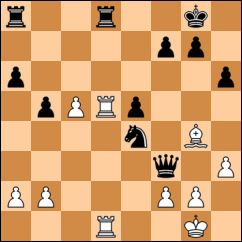
23...Red8??
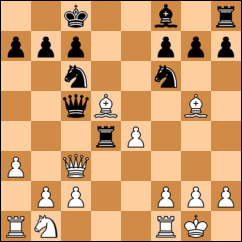
Jim really needs to get that knight out of the way of his e-pawn. This move gives me a chance to triple my heavies on the e-file with a threat on the knight as well: 24.Qd3! Rxd5 25.Qxd5 Rc8 26.Qxe4. After that, the bloodbath continues 26...Bxf3 27.Qxf3 Qxf3 28.Bxf3 Rxc5, heading into an endgame with white up a bishop for a pawn. Yow! That would have made an exciting finale to this game . . . if, y'know, any of it had actually happened.

24.h3 Bxf3 25.Bxf3 Ng5 26.Bg4 Ne4
Fritz says forget that -- instead, trade rooks on d5 and push the pawn!

27.Qf3 Qxf3??


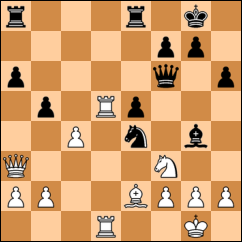
A straightforward queen trade, right? Wrong. What tactic are Jim and I both missing? (Highlight to reveal answer.)

28.Rxd8+!! Rxd8 29.Rxd8+ Kh7 30.Bxf3 and white goes into the endgame a rook ahead.

28.Bxf3 Rxd5 29.Rxd5 Nf6
Jim has to retreat the hanging knight, but 29...Ng5 gives him 30.Rxe5?! Nxf3+ 31.gxf3 Kf8, giving his pawn a respite (white needs to play 30.Bg4 to defuse the threat) and allowing it to advance.

30.Rxe5 Rd8 31.c6
A little imagination reveals that playing 31.Bb7 first both attacks black's a-pawn and guards the c-pawns promotion square.

31...Ne8? 32.Rc5
Lucky Jim. If I play 32.Re7, his a-pawn is history (32...Kf8 33.Ra7). He could have prevented it with 31...Kf8.

32...Nc7 33.b4 Rd2 34.a3 Ra2 35.Rc3 Ra1+ 36.Kh2 Ra2??


This move looks natural, but it's horrible! Watch what happens if white has his head screwed on straight: 37.Rd3!? Rxf2 38.Rd8+ Kh7 39.Rd7 Ne8 40.Rxf7. White regains his dropped pawn, and the knight is going to die falling on that little grenade on the c-file.

Note to self: When you're a pawn up, don't let the loss of a pawn stop you from looking for an attack.

37.Kg3
Bah. Sensible and tame. Not in the spirit of the position.

37...g6 38.Rd3
A move too late. After, say, 38...Kg7 39.Rd7? Ne6 is merely pitiful (40.c7?? Rc2).

38...h5??
The bad thing about this move is that it sorta kinda allows 39.Rd7 to work (39...Ne6 40.Bd5 Rxa3+ 41.f3 Rc3 42.Bxe6 Rxc6 43.Bxf7+ Kf8 drops the knight).

39.Bd1
I . . . I don't know what I'm thinking with this move. Bb3, maybe? 39.Rd7 is the only move worth considering.

39...Rb2??
I guess Jim is reading my mind and dodging the stupid move that I shouldn't make anyway.

40.Rd7 (finally) Ne6 41.c7 Nxc7 42.Rxc7 Rd2
Let's see, now . . . when you're a piece up in a straightforward, almost symmetrical endgame, what do you do?

43.Bb3?????????


Seriously, I have to give it that many question marks because of the utter delight with which it fills Jim. You see why, right? I'm not even going to insult your intelligence by making you highlight it.

43...Rd3+ 44.Kf4 Rxb3
Sigh.

"I've been waiting this whole game for you to make that one mistake you always make," crows Jim. Yeah, yeah. I'm not done fighting.

45.Ke5 Rb2 46.Ra7 Rxf2 47.Rxa6 Rxg2 48.a4 bxa4 49.b5??
49.Rxa4 is a no-brainer -- kills the a-pawn, defends the b-pawn. This dumb move just sets up a skewer.

49...Rg5+ 50.Kf6 Rxb5 51.Ra8+ Kh7 52.Kxf7 Rb7+
52...Rb3 followed by 52...Rxh3, roll credits.

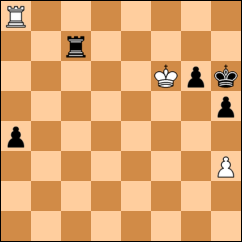
53.Kf6 Kh6
Goodness gracious . . . after all that, we're heading into draw territory.

54.Rh8+ Rh7 55.Ra8 Rc7


56.Rxa4??
If I just keep swooping in with Rh8+ and back out, I can force a threefold easily. Two pawns down, why am I still trying to win? It's not going to happen.

56...Rc3 57.Ra8??
Now Jim can check me, and I can forget about that forced draw.

57...Rf3+ 58.Ke5 Rxh3 59.Rh8+ Kg5 60.Rf8 Kh4 61.Rf4+ Kg3 62.Ke4 g5
Jim can force a win here with 62...Rh4! 63.Rxh4 Kxh4 64.Kf3 -- the g-pawn will promote.

63.Rf3+ Kg2 64.Rf5 g4 65.Rg5 g3 66.Kf4
I'm gambling that I can get Jim so cramped in the corner that he'll be forced to drop something.

66...h4 67.Kg4 Kh2 68.Kf3 Kh1
68...g2! 69.Ke4 Rg3 is Jim's only chance to force a win.

69.Kg4 g2??
Swindle achieved! (Jim needs to play 69...Rh2 first to save himself.)

70.Kxh3 g1Q 71.Rxg1+ Kxg1 72.Kxh4 ½-½

Thursday, May 20, 2010

Game of the Week

I chose this game for three reasons: because Steve McWhirter occupies the top of our club ladder, because it's a wild collision ultimately decided in the endgame, and because I can't remember the last time I saw a game that began 1.e4 e5.

G.Sargent–S.McWhirter
Route 20 Chess Club
Freeport, Illinois, May 18, 2010

1.e4 e5 2.Nf3 Nc6 3.d4 d6?
3.d4 is the Scotch Game. The standard answer is 3...exd4; "3...d6 gives a bad Philidor," Sam Collins dryly says in Understanding the Chess Openings, "with the knight committed to c6." (The Philidor Defense is 1.e4 e5 2.Nf3 d6.)

4.dxe5?
That being said, Gary's response to Steve's out-of-book move is also suboptimal. 4.Bb5 is more heavily favored, 4.Nc3 a bit less so.

4...Bg4 5.exd6 Bxf3 6.Qxf3 Qxd6
Gary seizes his opportunities and stands a pawn up.

7.Bc4 Qb4+ 8.Qc3 Nf6 9.a3 Qe7 10.0-0


Relinquishes the pawn advantage -- black's natural answer is 10...Nxe4. 10.f3 holds the line for white.

10...0-0-0
Not awful -- black's second-best move, actually -- but why pass up material equality when you're down?

11.Bg5
It's like Gary is asking Steve to take his pawn . . .

11...Rd4?
. . . and Steve is saying, "No, really, I couldn't"! (Although with his knight pinned, black now has to take with his queen, allowing white to swipe another pawn with 12.Bxf7.)

12.Bd5
What's the idea of this move -- to box in black's rook somehow? Gary has many better ways to tighten the screws on Steve, for instance, 12.Nd2 Nxe4 13.Qxd4 Nxd4 14.Bxe7 Nxd2 15.Bxf8 Rxf8, winning the exchange and clearing the center for cannon fire. There's even the cheap shot 12.Qh3+.

12...Qc5?


So much for an attack on e4. Steve should strike immediately with the gonzo 12...Nxd5 13.exd5 Qxg5 14.dxc6 Bc5.

13.Bxf6 Qxc3 14.Nxc3
Gary hasn't lost his decisive advantage, but contemplate the situation after the wicked 14.bxc3!: with a jab at black's rook, white gains time to evacuate his bishop from f6, leaving him a piece and a pawn up. Which just goes to show that Steve should have played 13...gxf6 instead of trading queens (something he should have avoided anyway, being down in material).

14...gxf6 15.Bxf7 Bd6 16.Nb5
16.Rad1!? challenges black's control of the open d-file.

16...Rxe4 17.Nxd6+ cxd6 18.Bd5
18.Rae1 Re7 19.Rxe7 Nxe7 looks good too. Even trades favor Gary right now.

18...Re2 19.Bxc6
The trouble with this, rather than an immediate Rac1!? (or the less favorable Rfc1), is that it throws away an active piece and gives Steve's pawns space and mobility. With nothing but rooks, kings and pawns in the field -- and with a black rook already on its seventh rank, while both white rooks are still on their first -- Gary's one-pawn material advantage looks a lot less significant.

19...bxc6


20.Rac1 Kd7 21.h3 a5
The open b-file and e-file are calling to Steve's undeveloped rook, but it doesn't hear.

22.Rfe1 Rd2 23.Kf1 Rb8 24.b3 Rb5 25.Re2 Rxe2 26.Kxe2 Re5+ 27.Kf1 h5 28.Re1 Rc5
With precise endgame play, Steve is keeping Gary from taking advantage of his extra pawn.

29.Re2 f5 30.a4 Rd5 31.Ke1 h4 32.Rd2 Re5+ 33.Kd1 Re4 34.Rd3 Rf4
Steve's first stumble in many moves, blockading his own f-pawn. Better to advance it.

35.Rf3
Gary repays the favor. 35.Ke2 seizes a chance to break out: 35...c5 36.c4 Re4+ 37.Kf3.

35...Rxf3 36.gxf3 f4


The door is slamming on Gary's winning chances. His extra pawn is useless now, trapped behind its compadre.

37.Kd2 c5 38.c4 Ke6 39.Kd3 Ke5 40.Kc3


40...d5??
A disastrous choice. Steve's best bet is to maintain the deadlock, and claim the draw, with a king move. Instead, the dominoes fall:

41.cxd5 Kxd5 42.Kd3 c4+?! 43.bxc4+ Kc5 44.Kc3! Kd6 45.Kd4 Kc6 46.c5 1-0
If Gary's c-pawn doesn't promote, his a-pawn will.