Wednesday, March 24, 2010

Game of the Week

This week's game begins with a curious opening:

K.Ammann–G. Sargent
Route 20 Chess Club
Freeport, Illinois, March 23, 2010

1.d4 e6
Aggressively lobbing the ball back into white's court. Does white play 2.c4, inviting a Queen's Gambit Declined, or 2.e4, turning the opening into a French?

I was getting over a cold, so I wasn't equipped to properly weigh the two options. On the one hand, opening principle told me, "Grab the center -- he's inviting it!" On the other hand, as a French player myself, I know what a pain the defense can be for white. I chose 2.c4, playing it safe. When I got home, I queried Fritz and ChessBase and found, intriguingly, that in the former's database, 2.e4 was favored nearly two-thirds of the time, while in the latter's, 2.c4 enjoyed nearly as great an edge. Gee, thanks for clearing that up!

In any event, Gary's follow-up was a surprise curveball:

2.c4 c5!?
After the game, Gary told me that he'd planned to play 2...c5 regardless of whether I played 2.c4 or 2.e4. I was a little boggled by this. Surely, I thought, there must be some refutation to 2.e4 c5 -- otherwise, wouldn't black play 2...c5 all the time instead of going into the well-studied French Defense? Yet the most common reply, 3.Nf3, gives white only 50/50 chances.

The answer appears to be 3.d5. Exchanging pawns on d5 is just fine for white -- better than fine if, instead of 4...d6, black follows up with 4...Nf6? (5.Qe2+ Qe7 6.Nc3 Qxe2+ 7.Bxe2 Be7 8.d6 guarantees a grumpy black) . Both 3...Nf6 and 3...d6 are effectively squelched by 4.Nc3; 3...a6 is answered by 4.a4. White has an edge in every case.

As for the 2.c4 c5 scenario, it seems that my response was the correct one:

3.d5 d6 4.Nc3 Be7? 5.Nf3 Nf6 6.e4 e5
Fritz is hilariously unable to decide whether this opening sequence is a Czech Benoni or a Blumenfeld Gambit.

7.Be2 0-0 8.0-0
Before castling, I briefly consider 8.Bg5. This move must be obvious to a more experienced player, because Gary promptly shuts this idea down (though Fritz reassures me that castling is the right idea).

8...h6
It's intriguing how many players in the ChessBase database choose to play 8...Ne8 here -- more than all other moves put together. Fritz, on the other hand, prefers 8...Nbd7.

9.Rb1 Bg4 10.b4 b6 11.bxc5 bxc5
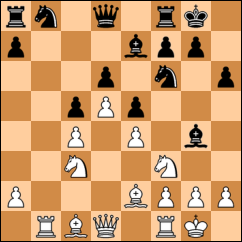


Like me, Gary likes a good traffic jam. In this case, though, I've got an open lane. I'm perhaps too eager to take advantage of it.

12.Qb3 a6 13.Qb7 Nbd7 14.Bd2 Qb8 15.Na4??
I'm badly overestimating my chances following a queen trade, not to mention unwittingly leaving my e4-pawn defenseless. Instead, I should get my queen out of the way with 15.Qc6 -- discovering an attack against Gary's -- and use the tempo to put my rook on b7.

15...Qxb7 16.Rxb7 Rfb8 17.Rfb1 Rxb7 18.Rxb7 Rb8 19.Rxb8 Nxb8 20.Ba5 Nbd7
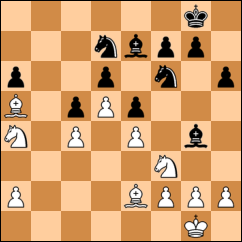


21.Nc3
Yikes! I suddenly notice the hanging pawn and send its defender back to its post. Material is even; I retain a slight positional advantage.

21...Nh7 22.h3 Bh5 23.Nh4
This is a mistake: I fail to notice that h4 is covered by Gary's dark-square bishop. Best here is a tricky sacrifice, 23.Nxe5!? Nxe5 24.Bxh5 Nxc4 25.Bc7.

23...Bxe2 24.Nxe2??
Having shortsightedly placed my knight in danger on h4, I may as well finish carrying out my plan with 24.Nf5 rather than leave it hanging.

24...Bxh4
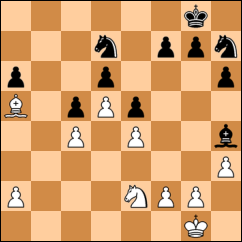


Advantage: Gary. And it's not a small one -- he's a whole piece up. Because of this, the rest of the game will be an uphill struggle for me.

25.Bc7 Be7 26.Ng3 g6 27.f3 Ndf6 28.Nf1 Ne8 29.Bb6 Nhf6 30.g4 Nd7 31.Ba5 Ng7 32.Kf2 f5 33.Ke2 Nf6 34.Nd2
My poor pieces are just too slow. There's no way I'm going to get them over to the queenside to take on Gary's a-pawn before he overwhelms me on the kingside.

34...fxg4 35.hxg4 h5 36.g5 Nd7 37.Bc7 Ne8 38.Ba5 Bxg5 39.Nf1 Bf4 40.Kf2 Ndf6 41.Kg2 h4 42.Bd8 g5 43.Nh2 Kf7
Allows 44.Ng4 Nxg4 45.fxg4 Nf6 46.Bxf6 Kxf6, but that only hastens what's going to happen eventually anyway.

44.a4 Kg6 45.Be7 Kf7 46.Bd8 Ng7 47.Kh3 Bxh2 48.Kxh2 Ngh5 49.Kh3 Nf4+ 50.Kh2 g4 51.Bxf6 Kxf6 52.fxg4 Kg5 0-1
There's no need to play this out to see how it's going to unfold. The g-pawn is toast, and I'll soon be doomed to eternal zugzwang.

Wednesday, March 17, 2010

Game of the Week

Since the $5 Open, one of the players in that tournament, Relton Sharp, has been a regular visitor to our open game nights. This week, just after I knocked Bill Koester off the top of the ladder, Relton did the same to me in this game, which was quite balanced for the first 28 moves.

K.Ammann–R.Sharp
Route 20 Chess Club
Freeport, Illinois, March 16, 2010

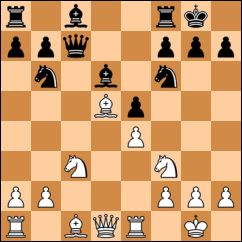
1.d4 d5 2.c4 c6 3.Nf3 e6!? 4.e3 Bd6?
Relton is waiting an awfully long time to play ...Nf6.

5.Nc3 Nd7 6.Be2
In a Semi-Slav setup like this, my bishop belongs on d3.

6...Ngf6 7.0-0 dxc4 8.Bxc4 0-0 9.Re1 Qc7 10.e4 e5 11.d5 cxd5 12.Bxd5 Nb6??


Why is 12...Nb6 a mistake? (Highlight to reveal answer.)

13.Nb5! Qc5 14.Nxd6 Nbdx5 15.Nxc8+− wins a bishop.

13.Bg5
I miss the killer move, settling for a merely balanced position.

13...Nfxd5 14.exd5 a6 15.Rc1
I'm beginning to gain an edge.

15...Bg4 16.Qd3
Breaking the pin while still defending the knight -- but white can win a pawn with 16.Na4 Nc4 17.b3 h6 18.Rxc4 Bxf3 19.gxf3 Qb8 20.Bxh6 gxh6. (I almost wrote, "I could have won a pawn with . . . ," but that would have been absurd -- I never would have thought of that sequence.)

16...Bxf3 17.Qxf3 Qd7 18.Re4
I'm letting my edge slip away.

18...f5 19.Rh4 Qf7


That isolated pawn is the center of attention -- at least, Relton's attention. I, on the other hand, am preoccupied with building up a kingside attack, so I miss the cheeky potential of 20.Be3!?.

20.Qh5 Qxh5 21.Rxh5 f4
Not sure what Relton is thinking here -- trying to trap my bishop, maybe? 21...Rac8 is timely.

22.Ne4 Bb8?
Instead of seizing the c-file with 22...Rfc8! 23.Rd1 Bf8.

23.Be7 Rf7??
Still not taking the c-file!

24.Bd6??
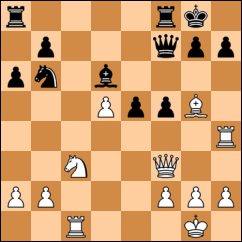
A muffed opportunity: 24.d6 backs up the bishop while cutting off protection of the e5-pawn, letting me pick it up for free and giving me a decisive advantage. Instead, I'm letting the game swing in Relton's favor. I remember thinking this move was OK because material would still be even, and I'd get a couple of tempo moves out of it. Yeah, not right.

24...Bxd6 25.Nxd6 Re7 26.Nf5 Rd7 27.d6 g6 28.Rg5 Kf7


29.Rc7??
The game-losing blunder. At the very least, I should have evacuated my knight with 29.Nh6+ Kg7 30.Ng4. Relton would still have had an advantage, but it wouldn't have been as decisive.

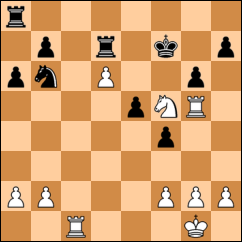
29...gxf5 30.Rxf5+ Ke6 31.Rh5 Rh8
Black can force a favorable rook trade with 31...Rc8 (32.Rxb7?? Rc1#).

32.Rh6+ Kd5 33.b3 e4 34.a4 Rxd6 35.Rxb7
One last screw-up, for the sake of thoroughness. 35.Rxd6+ Kxd6 36.Rxb7 was necessary for me to have any hope of survival.

35...Rxh6 36.a5 Nc8 37.Rb8 Re8 38.Kf1 Rxh2 39.Ra8 f3 40.gxf3 exf3 41.Kg1 Rg2+ 0-1
I can wriggle around a while longer with 42.Kf1 Nd6 43.Rxe8 Nxe8, but why bother?

Wednesday, March 10, 2010

Game of the Week

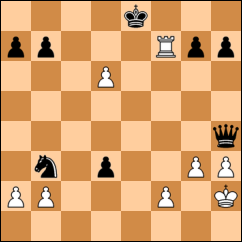
This game, between me and new member Ryan Ekvall, was so entertaining, I had to give it a name. I call it "The Zombie Queen Will Not Stay Dead."

R.Ekvall–K.Ammann
Route 20 Chess Club
Freeport, Illinois, March 9, 2010

1.d4 d5 2.Nf3 Bf5?! 3.c4 Bxb1
A bit of a gonzo start.

4.Rxb1 e6 5.Bf4 Bd6
Cedes an edge to white, while 5...dxc4 maintains equality. But I have an aversion to the QGA, and I thought it would be interesting to trade off my bishops and try to lock up the position.

6.e3 Bxf4 7.exf4
I realize too late that I've given Ryan a potential outpost for his knight on e5. Oops. Gonna have to be careful with that. On the other hand, I've also created a good one for myself on e4, so if I can get to it quickly, I can use my f-pawn to keep Ryan's knight away.

7...Nf6 8.Be2 Ne4 9.0-0 Nd7 10.Bd3
Threatening a trade. I don't like what that will do to my pawn structure, so I back off.

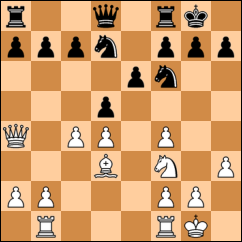
10...Nef6 11.Qa4
Failing to press his newly gained advantage. 11.f5 would have been ouchsome.

11...0-0 12.h3
I don't get this move. It covers g4 against my knight, but I don't have any reason to advance that piece; the kingside isn't where the action is right now. The bigger threat, now that I've broken the pin on my knight, is 12...Nb6. 12.c5 would stop that cold.


At this point, I realize that my thinking process has been pretty sloppy so far, and I make a conscious effort to tighten it up.

12...c5
Second-best to 12...Nb6 (I'm still not liking 12...dxc4, no matter what Fritz says). But it has the desired effect -- better, in fact.

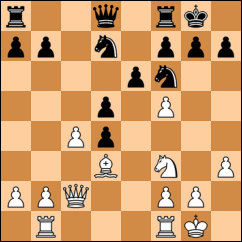
13.Qc2
Ryan could have maintained equality by blowing up the center: 13.dxc5 Nxd5 14.dxc5 Nxc5 15.Bxh7+ Kxh7 16.Qc2+ Kg8.

13...cxd4 14.f5
14.cxd5 is still Ryan's best move, but it's lost some of its potency, because I can easily gain control of the open c-file: 14...Rc8 15.Qa4 Nc5 16.Qxd4 Qxd5.


My next move, 14...Rc8, is almost childishly obvious. But there's a non-obvious move that gains a decisive advantage for black. What is it? (Highlight to reveal answer.)

14...e5!? 15.cxd5 Rc8 (15...e4 16.Bxe4 Rc8 17.Qe2 Re8) 16.Qe2 e4 17.Bxe4 Re8 18.Nd2 Nc5, threatening 19...Nxe4. No, I didn't see it either.

14...Rc8 15.fxe6
Not 15.Nxd4 e5 16.Nb5 a6.

15...fxe6 16.Ng5 Ne4??
Once again, I'm spacing out: Ryan is threatening a fork on e6, and I'm not even seeing it.

17.Nxe6
Time for some serious evaluation of my options. Clearly, if I let Ryan take my queen, I'm sunk. I can evacuate it to h4 and take aim at f2 while also protecting my underdefended d4-knight. Now, how bad is it if I let him take my f8-rook? I lose the exchange, obviously, but I'm up a pawn to begin with. I have my choice of three pieces with which to capture his knight. If I recapture with the c8-rook, I'm giving up a pin but retaining pressure on the f-file, but f2 is too well defended for me to break through at this time. Do I want to let my king be dragged out into the open? Not particularly, which leaves the last option: to retake with the knight. It's left on the edge of the board, but that's not awful, I suppose, since it's my least active piece anyway. So . . . course of action decided.

17...Qh4 18.Nxf8 Nxf8 19.cxd5
Willingly giving up his queen for a passed pawn! Even if the c4-pawn hadn't been pinned, this move is shortsighted: 19.Rfe1 puts unbearable pressure on my knight, forcing him to retreat. 19...Nd6 is then followed up by 20.c5. White has the initiative and owns the e-file free and clear.

There's also another nasty side effect to 19.cxd5, which wasn't even evident to me until I was right on top of it:

19...Rxc2 20.Bxc2 Nd2
Ow. Most unfortunate.

21.d6 Nxf1 22.Rxf1 Nd7
I'm having tunnel vision. I'm thinking about the pawn's promoting. I should be thinking about the seventh-rank outpost square Ryan has just created for his rook. 22...Qf4 would have neutralized this strategic threat.

23.Re1 Kf8 24.Re7
Now the knight is hanging, and I'm forced to get creative again.

24...Nc5
It's better with the in-between move 24...Qh6 25.Ba4 (25.Rxd7 Qc1+ 26.Kh2 Qxc2) Nc5.

25.Bb3 d3 26.Rf7+ Ke8
I ruled out 26...Kg8 on the basis of 27.Rf4+ Nxb3 28.Qxh4. But if I'd thought one move further ahead, I might have seen 28...d2! There was nothing to fear.

27.Kh2 Nxb3 28.g3


Cheeky counterplay! I studied this position for a bit but didn't think of the very best move, 28...Qd4, which is mate in 10 -- or any other straightforward queen evacuations, for that matter. But I did see something that made me laugh: a way to defuse the tension in the position and maintain my material advantage at the same time. What the hell, I thought.

28...d2!? 29.gxh4 d1Q
"The Zombie Queen will not stay dead!" I proclaimed. (If I'd been less amused with myself, however, I might have noticed that the Zombie Queen could have rested in peace for a move while I snagged the hanging rook with 29...Kxf7.)

30.d7+ Kd8
I don't know why I failed to notice that the pawn's promoting is no threat after 30...Kxf7.

31.axb3 Qxb3 32.Rxg7 Qxb2 33.Rg2 Qe5+ 34.Rg3 Kxd7
One less thing to worry about.

35.f4? Qxf4 36.h5

Now is the time on Sprockets when we dance:

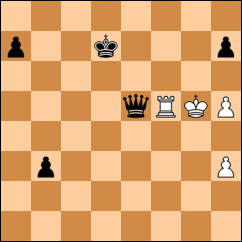
36...Qf2+ 37.Rg2 Qf4+ 38.Rg3 b5 39.Kg2 Qe4+ 40.Rf3 b4 41.Kg3 Qe5+ 42.Rf4 b3 43.Kg4 Qe2+ 44.Kg5 Qe5+ 45.Rf5


What should black do? (Highlight to reveal answer.)

45...Qxf5!+ 46.Kxf5 b2 47.Kf6 Kd6 48.Kg7 b1Q
"Dude," I said, "I warned you about that Zombie Queen!"

49.Kh6 Ke5 50.h4 Qb6+
Overanxious to avoid stalemate, I overlooked the neat 50...Qb7 51.Kg5 Qg7#.

51.Kxh7 Qf6
Another missed mate: 51...Kf6 52.h6 Kf7 53.h5 a5 54.Kh8 Qxh6#.

52.h6 Kf5
Another missed mate: 52...Qf7+ 53.Kh8 a5 54.h5 a4 55.h7 Qf8#. I could make a book of these, or at least a pamphlet. But I won't bore you with any more of them here.

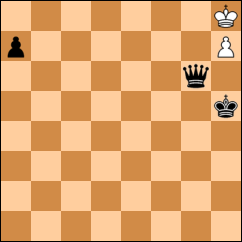
53.h5 Kg5 54.Kg8 Kxh5 55.h7 Qg6+ 56.Kh8


What do you think is going to happen? No peeking, now.

56...Qxh7! 57.Kxh7 a5 58.Kg7 a4 59.Kh7 a3 60.Kg8 Kg6 61.Kf8 Kf6 62.Kg8 a2 63.Kh7 a1Q
"The Zombie Queen . . . will not . . . stay . . . dead!"

64.Kh6 Qh1# 0-1