Sunday, May 22, 2011

Pecatonic Octads

Perhaps it should have been called "Pecatonic Octad," since we fell just one player short of creating a second group of eight. Still, this experimental format proved a success in other ways: the longer time control drew our strongest field of players to date, including Expert Glen Gratz (who won the octad), and the event was our first truly tri-state tournament, with representation from both Iowa and Wisconsin.

The octad pitted eight players ranging from Class C to Expert against one another in a three-round, G/65 Swiss. Glen fought off Joe Willett from the Quad Cities' Illowa Chess Club, Phil Jarrette of Elgin and a player from our own backyard, Ben Spinello, who was around for the first few meetings of the Route 20 Chess Club, then disappeared on us, only to reappear Saturday having become scary strong. (McHenry Area Chess Club members will have been aware of his ascent over the past two years; we were caught by surprise.)

Thirteen other players faced off in a four-round, G/45 Swiss, in which Cliff Adams and Gary Sargent, who complain that they always end up paired against each other, forced it to happen yet again by both winning their first three games. Bill Feldman of the DeKalb Chess Club, a frequent backdrop against which this drama plays out, suggests that there should be a traveling trophy for the two to pass back and forth. On Saturday, it was Cliff who won the as-yet-notional Adams-Sargent Cup, along with the reserve section's $20 first prize.

Complete results may be found on our tournament results page; click here for official crosstables and post-event ratings.

P.Jarrette–G.Gratz
Pecatonic Octads (2)
Freeport, Ill., May 21, 2011

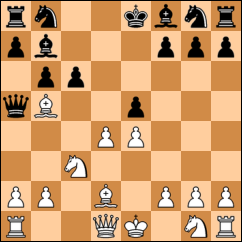
1.c4 e5 2.Nc3 c5 3.g3 Nc6 4.Bg2 d6 5.Nf3 Be7 6.0-0 Bg4 7.d3 Qd7 8.Nd5 h5 9.h3 Bxh3
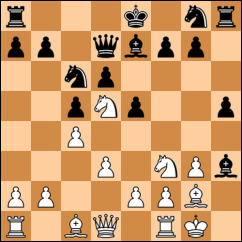


10.Nc7+
Premature, and much more risky than the riskier-looking bishop trade 10.Bxh3 Qxh3 11.Nc7+ Kd8 12.Nxa8. If black immediately takes the forward knight, he can crack open the cover around white's king like an oyster: 10...Qxc7 11.Bxh3 h4.

10...Kd8
Glen lets Phil have his way, putting himself at a disadvantage.

11.Nxa8 h4 12.Bg5
Significantly better is 12.b4!? Nxb4 13.Bd2, threatening to take the black knight out of the picture. White needs to let the h-pawn be for now: 13.Nxh4 Rxh4 14.Bh1 (14.gxh4?? Qg4, mate follows on g2) 14...Rh8 is quite satisfactory for black, while 13.gxh4?? is simply careless; after 13...Bxg2 14.Ng5 Bxg5 15.Bxg5+ f6, white is doomed to lose another piece.

12...f6 13.Be3 hxg3 14.fxg3 Nh6?
Glen shouldn't be giving Phil opportunities to trade. 14...Kc8 is something to consider.

15.Bxh6 Rxh6 16.Kf2 Bxg2 17.Kxg2 Qh3+ 18.Kf2 Rg6 19.Rg1 f5 20.Qf1 Qg4 21.Ke1 e4
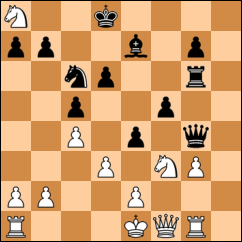


22.Nd2??
22.dxe4!? fxe4 23.Nh2 holds on to the edge that Phil has enjoyed. The passive 22.Nd2 gives Glen the chance to even things up again.

22...Nd4 23.e3??
Another flub! Perhaps Phil was feeling time pressure -- for much of the latter part of the game, Glen had roughly twice as much time left on his clock as Phil had on his. Here, Phil's best chance is 23.Nb3 exd3 24.Nxd4 Qxd4 25.Rh1 Qxb2 26.Kf2.

23...Nc2
Glen is in command now.

24.Kf2 Nxa1 25.Qxa1? (25.dxe4 fxe4 26.Qb1) 25...exd3
Yet, just two moves later, his command wavers. 25...Bh4 26.Nf1 Qf3+ 27.Ke1 f4 keeps the pressure on.

26.Qf1 f4
26...Bh4 no longer heralds the arrival of a demolition crew, but rather a request for a repetition draw: 27.gxh4 Qxh4+ 28.Kf3 Qh5+ 29.Kf2 Qh4+ 30.Kf3 Qh5+ 31.Kf2 Qh4+ ½-½. But 26...f4 is reckless, giving Phil a chance to seize back the advantage.

27.exf4 (not 27.Qxd3 fxe3+ 28.Qxe3 Bg5) 27...Bf6 28.Nf3 Qf5 29.Qd1
29.Qe1!? Kc8 30.Rh1, dominating the open files, is much better.

29...Qe4
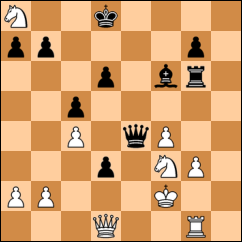

Glen is about to come roaring back.

30.Re1?? Bd4+ 31.Nxd4 Qxd4+ 32.Kf3??
32.Kg2 Qxb2+ 33.Kh3 is the only escape.

32...Qxc4
Something of a thank-you move for white. In contrast, 32...d2! 33.Rg1 Re6 (or 33...Qd3+ followed by 34...Re6) is devastating.

33.Re3 Qd5+ 34.Kf2 d2 35.Re8+
Trying to set a trap -- a little transparently. 35.Ke2 is safer, despite 35...Qg2+ 36.Kd3 Rxg3, since 37.Rxg3 Qxg3+ 38.Kc2 Qe1 39.Qxd2 Qxd2+ 40.Kxd2 defuses a lot of the tension in the neighborhood. Even so, black holds a decisive advantage.

35...Kd7 36.Qa4+ Qc6 37.Qc2
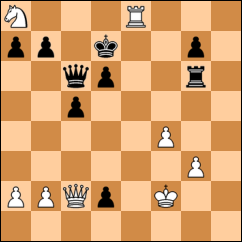


37...d1N+!
Rescues the g6-rook by distracting white's queen. (37...d1Q! works also.) In contrast, 37...Kxe8 38.Qxg6+ Kf8 39.Ke2 concedes a draw.

38.Qxd1 Kxe8 39.Qh5 Qe4 40.f5 Qc2+ 41.Kg1 Qc1+ 42.Kh2 Qh6 43.Nc7+ Kd7 0-1
There's nothing left for white.

Thanks again to all who attended. Our next rated event will be at Highland Community College on Saturday, July 9, format to be determined; if you have a request or a suggestion, please leave a comment or e-mail us at route20cc@gmail.com. (And yes, we know that air conditioning is at the top of everyone's list!)

Wednesday, May 18, 2011

Positions of the Week

Usually I like to present a reasonably close game, but this was a week of drubbings. Therefore, rather than an entire game transcript, here are some interesting positions (anonymized to protect my sources):

Game No. 1
Route 20 Chess Club
Freeport, Ill., May 17, 2011


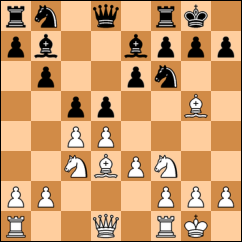
White to move. White has just played 1.Bb5+, which black has answered with 1...c6. Has white played a clumsy, thoughtless check that dooms him to lose a tempo -- and his d-pawn, and another tempo after that -- or does he have an ace up his sleeve? (Highlight to reveal answer.)

Black's queen is a goner after 2.Nd5!! White already has an almost insurmountable winning advantage, but black can salvage some dignity with 2...Qxb5 3.Nc7+ Kd7 4.Nxb5 cxb5, taking two white pieces for the doomed queen.


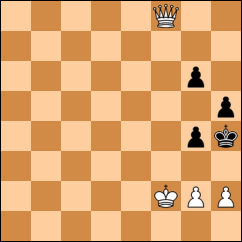
Black, hopelessly outgunned, is after a stalemate. Can he get one? (Highlight to reveal answer.)

Sadly, no: 1.Qf4! (1.Qf6+ g5 2.Qc3 g3+ 3.Qxg3#) 1...g5 46.Qg3#. The actual game went 1.h3!? gxh3? (1...Kg5 2.h4+ Kxh4 3.Qd8+ g5 4.Qd6 g3+ 5.Qxg3#) 2.gxh3?! (2.Qf4#) 2...Kxh3 (2...Kg5 3.h4! Kxh4 4.Qf4+ Kh3 5.Qg3#) 3.Qf3+ Kh4 4.Qg3#.


Game No. 2
Route 20 Chess Club
Freeport, Ill., May 17, 2011


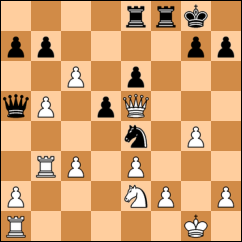
This time it's black's turn to be tricky. In this otherwise equal-looking position, what can black do to give white a real headache? (Highlight to reveal answer.)

1...Nd2! threatens a royal fork on f3. 2.Nd4 stops the threat; 2...Nxb3 3.Nxe6, and black has the advantage.

Wednesday, May 11, 2011

Game of the Week

Wow! Major churn this week in our usually placid ladder. Eighth-grade up-and-comer John Werkheiser scored a point against the encyclopedic Gary Sargent, then got his own bell rung by our resident park hustler, Steve Black, who in turn let one go to Monica Kearney; while Ken Conter caught me zoning out in an endgame and beat me with a king-rook fork. At least one thing remains constant: It's very, very difficult to beat Will Engel.

K.Ammann–W.Engel
Route 20 Chess Club
Freeport, Ill., May 10, 2011

1.d4 d5 2.c4 e6 3.Nc3 Nf6 4.Nf3
I know this is a perfectly legit book move and all, but I always mean to play 4.Bg5, and I always forget. Grrr.

4...b6?!
An odd moment, and an odd way, to go out of book. And kind of an odd choice in general -- I know so little book, there's no real advantage in going out of it against me.

5.Bg5 c5 6.e3 Bb7?
The fianchetto seems natural, but if I were playing more aggressively, 7.cxd5 Be7 (≤7...exd5 8.Bb5+ Bc6 9.Qa4 Bxb5 10.Nxb5+−) 8.Bb5+ Kf8 9.dxe6 would set me up pretty nicely.

7.Bd3 Be7 8.0-0 0-0


9.Qc2
I'd call this my first real miscue of the game. It's not even that serious an error, more like a missed opportunity to do the most right thing: 9.cxd5 Nxd5 10.Bxe7 Qxe7 11.Nxd5 Bxd5 12.dxc5 Nd7. I guess I just don't feel ready to set off the fireworks yet.

9...h6
Incidentally, by not setting off the fireworks, I leave Will a chance to grab a slight advantage with 9...dxc4!? 10.Bxc4 Bxf3 11.gxf3 cxd4.

10.Bxf6 Bxf6 11.cxd5 exd5 12.e4 cxd4 13.Nxd5 Nc6 14.Rac1 Rc8 15.Qa4 Ne5 16.Nxe5 Bxe5
Will should preempt 17.Rxc8 Bxc8 18.Qxa7 with 16...Rxc1 17.Nxf6+ Qxf6 18.Rxc1 Qxe5 19.Qxa7 Bxe4.


I've been playing a competent game so far. Time to do something about that.

17.Ba6??
Seeking to trade my bad bishop for Will's sniper. Alas, not only does a rook trade give him the tempo he needs to dodge my attack . . .

17...Rxc1 18.Rxc1 Bxd5
. . . but, in fact, if he calls my bluff with 18...Bxa6!? 19.Qxa6, then 19...Qh4! wins my e-pawn.

19.exd5 Qxd5 20.Bc4
20.Bd3 is slightly better.

20...Qd6
I see the battery, and I see the easy way to thwart it (21.g3). But now, reasoning spuriously that I'm unlikely to win against Will anyway and so may as well try something and see what I learn from it, I play my next bonehead move:

21.Qxa7? Bxh2 22.Kh1 Bf4 23.Bxf7?? Rxf7
It's good to remember that kings can in fact defend other pieces.

24.Rc8+ Rf8 25.Rc7
A piece down, but clinging to a bad idea like a terrier.

25...Qf6 26.g3


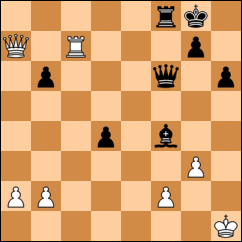
What's the move that wins the game for Will? (Highlight to reveal answer.)

26...Bxg3! 27.fxg3 (27.Rxg7+ merely postpones the inevitable: 27...Qxg7 28.Qxg7+ Kxg7 29.Kg2 d3 30.f4 Bxf4 31.b4 d2 32.a3 d1Q 33.Kf2 Bd6+ 34.Ke3 Rf3+ 35.Ke4 Qd3#) 27...Qf1+ 28.Kh2 Rf2# 0-1