Wednesday, September 29, 2010

Game of the Week

In which our newest member, Will Engel, seizes the top spot on the ladder with his fifth consecutive win. It's going to be tough to take it away from him!

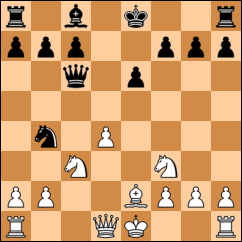
W.Engel–S.McWhirter
Route 20 Chess Club
Freeport, Ill., Sept. 28, 2010

1.d4 d5 2.c4 e6 3.Nf3 Nf6 4.Bg5 Be7 5.e3 0-0 6.Nc3 b6?
The first slip in a slightly offbeat but otherwise accurate Queen's Gambit Declined. Better is 6...h6 or 6...Nbd7, since Will has raised the issue of a minor piece trade on f6.

7.Qc2 Bb7 8.Ne5
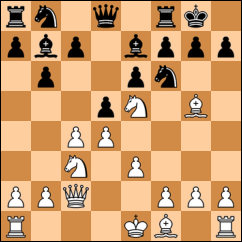


8...dxc4 9.Nxc4 Nc6 10.f4 Nd5
Thanks to his decision to fianchetto the queen's bishop, Steve has an interesting and potentially powerful rushing play in 10...Nb4!? 11.Qe2 Ne4, with the likely continuation 12.Bxe7 Qxe7 13.Nxe4 Bxe4.

11.Bxe7 Qxe7 12.0-0-0
A risky choice: Will castles his king onto a half-open file on the side of the board where all the action is. Steve seizes the moment.

12...Ncb4 13.Qd2 Nxc3 14.bxc3 Nd5 15.Bd3?!
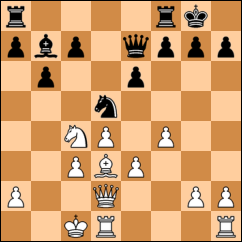


Danger! All Steve has to do is kick Will's knight off c4 with 15...b5!, then come barreling in with 16...Qa3+, and at a minimum he wins a pawn, possibly two, and Will's king is out in the great open spaces where cats are cats.

15...g6??
Steve misses his moment, and Will has a chance to rebound.

16.e4 Nf6 17.Rhe1 Ba6
Steve's rooks are not looking especially active. 17...Rfd8 is one solution to that.

18.f5 Bxc4 19.Bxc4 exf5 20.exf5 21.Ne4


21.Qb2
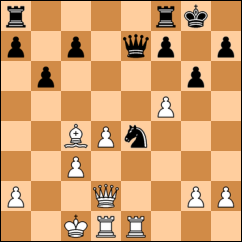
Now it's Will's turn to miss an opportunity: Without careful replies, 21.Bd5!? wins material. Black can avoid the worst with 21...Qa3+ 22.Qb2 Qxc3+ 23.Kb1 (23.Qxc3 Nxc3 24.Bxa8 Nxd1 25.Bc6 Nf2) 23...gxf5 24.Bxa8 Rxa8 25.Rc1, where black loses the exchange but wins two pawns. With 21...gxf5, black gets only one pawn in compensation.

21...Qg5+ 22.Kb1 Nd6
Steve can't play 22...Qxf5? because of 23.Bd3 Rae8 24.Qc2, which can only be resolved by 24...Nxc3+ 25.Qxc3. This leaves him down a bishop for two pawns, and Will has the initiative.

23.Bd3 Nxf5 24.Qb5 Qxg2??
This move leaves Steve's knight underdefended. Will wins a pawn, and Steve's king loses its cover. Much better is to slam the door in the queen's face with 24...c5, then answer 25.Re5 with 25...Qg4, threatening to seize Will's other rook (25...cxd4 is inferior, because the threat against the knight is renewed: 26.Bxf5 gxf5 27.Rxf5).

25.Bxf5 gxf5??
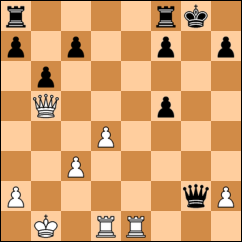


Steve is in fact better off letting the bishop live and grabbing a free pawn with 25...Qxh2 instead; if 26.Be4 then 26...Rae8. Will's pieces are more active by far, but at least material is equal. Here Steve seems to be two pawns up, but the removal of his king's cover leaves him tragically vulnerable . . .

26.Rg1 1-0
Even after 26...Qg6 27.Qxf5 Rae8, Steve's queen is on life support. 28.h4 Kh8 29.Rxg6 pulls the plug.

Wednesday, September 22, 2010

Find the Best Move

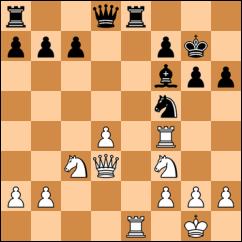
I don't know about other players, but for me, this was a real week for tricky tactics -- a couple that I perpetrated myself, and one that clobbered me so elegantly I was momentarily dumbstruck. Thus, rather than a Game of the Week, I present a selection of "best move" challenges.

First, an easy one for the kids.

K.Ammann–S.Prue
Route 20 Chess Club
Freeport, Ill., Sept. 21, 2010


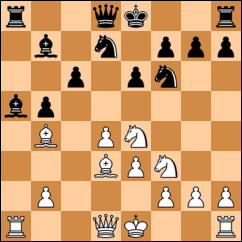
White to move. (Highlight to reveal answer.)

1.Bb5 0-0 2.Bxc6 Nxc6

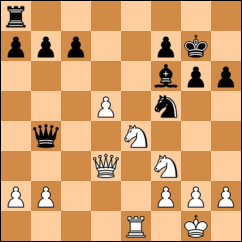
Now for something more challenging:


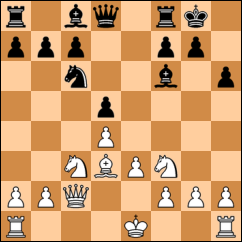
White to move. (Highlight to reveal answer.)

1.Nc6! Bxc6 2.Rxd8 Bd5 3.Qxb6


J.Carter–K.Ammann
Route 20 Chess Club
Freeport, Ill., Sept. 21, 2010


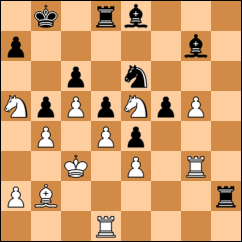
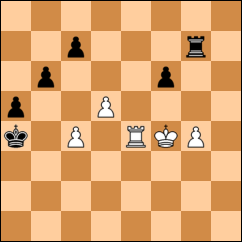
Black to move. (Highlight to reveal answer.)

1...Bxe5 2.dxe5 d4!
This sets off a complicated chain of variations. White's best response is 2.Rxd4 Nxd4, but caution is required, because if white doesn't play 3.exd4, then 3...Rc2# is immediate mate, while 3...Rg2 and 3...Nxc6+ merely prolong the inevitable.

3.exd4 Rxd4?!
A wise-fool play on my part. I'm thinking about material, but I need to be aware of Jason's passed g-pawn. 2...f4 scores a palpable hit, forcing back the g3-rook (3.Rgg1) and giving me a check (3...Rh3+) which in turn lets me advance my e-pawn as well (4...e3). However, even after 3...Rxd4, black has to walk a tightrope to come out ahead . . .

4.Rxd4 Nxd4 5.g6?? Ne2+ 6.Kc2 Nxg3+
. . . and 5.Kxd4 f4 6.Rg4 Rxb2 7.g6 Bxg6 8.Rxg6 is the only way to avoid falling.


W.Engel–K.Ammann
Route 20 Chess Club
Freeport, Ill., Sept. 21, 2010


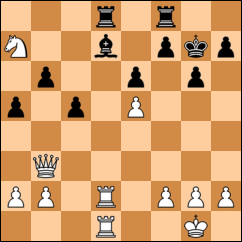
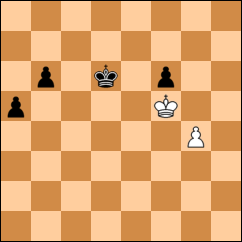
White to move. (Highlight to reveal answer.)

1.Nd6 Kf8 2.Rxa5 (≤2.Nxb7+ Bxb4+ 3.Kf1 Qb8 4.Rxa8 Qxa8) 2...Rxa5 (2...Qe7 3.Rxa8+ Bxa8) 3.Nxb7+
A check and a queen-rook fork simultaneously. How articulate would you be after that?

Wednesday, September 15, 2010

Game of the Week

K.Ammann–S. McWhirter
Route 20 Chess Club
Freeport, Ill., Sept. 14, 2010

1.d4 d5 2.c4 e6 3.Nc3 Nf6 4.Nf3 Nc6
Although 4...Nc6 looks like a book move, it actually works out poorly for black on average, no doubt because it inhibits the advance of black's c-pawn.

5.Bg5 Be7 6.e3 0-0
A more critical response for black is 6...b6 7.cxd5 exd5. As played, a good plan for white is to play Bd3, a3 and 0-0, while black can consider h6, b6 and Bb7.

7.Bd3 h6 8.cxd5 exd5 9.Bxf6 Bxf6 10.Qc2


Not a particularly good idea for various reasons, the most salient of which is 10...Nb4. 10.a3 being unnecessary because of the bishop trade, better choices for me are 10.0-0, 10.Rc1 and 10.Qb3, in response to any of which Steve should pull his knight back to e7 and advance his c-pawn to support d5.

10...g6 11.0-0 Ne7 12.Rfe1 Re8 13.e4 dxe4 14.Rxe4 Bf5 15.Rf4 Bxd3
Steve can manhandle the rook with 15...Bg5, forcing a trade with 16.Nxg5 hxg5 and ending up with the initiative and a slight advantage after 17.Rf3.

16.Qxd3 Kg7 17.Re1 Nf5


A battle royal is shaping up around d4, and I have to be careful, because if I let Steve initiate it, ...Rxd1 will be the end of me. 18.Rxe8!? Qxe8 19.g4 defuses the attack and puts Steve on the defensive, but I opt for something more wu-wei.

18.d5?!
Positionally, it's not much, but it puts Steve on tilt.

18...Qd6 19.Rfe4! Rxe4 20.Nxe4
Not the inferior 20.Rxe4 or 20.Qxe4, either of which lets the initiative slip away and gives Steve a chance to ratchet up the pressure on my d-pawn again with 20...Rd8.

20...Qb4??


Walks into a trap I wish I knew I was setting. It begins with 21.Nxf6!; 20...Qe7 defuses it.

21.Nxf6!
Threatening to win the exchange with 22.Ne8+ Rxe8 23.Rxe8. But there's even more nastiness packed into this apparent trade offer that isn't really.

21...Kxf6??
The obvious move, right? What could be wrong with it?

There's a surprising killer move here. Don't feel bad if it escapes you; I'd never have thought of it either. (Highlight to reveal answer.)

The unassuming 22.a3!! leaves black bereft of chances. His best reply is 22...Qxb2 23.Rb1 Qxb1+ 24.Qxb1, where white wins a queen for a rook and a pawn. Next-best is 22...Qxe1+ 23.Nxe1 -- white has only a queen for a rook, but black will fall apart after 23...Ke7 24.Qe4 or 23...Rc8/d8 24.Qc3+. If black's queen runs, abandoning the defense of c3 leads to a mating net -- e.g., 22...Qa5? 23.b4 Qa4?? 24.Qc3+ Nd4 25.Qxd4+ Kf5 26.g4# (23...Qb6? only prolongs the inevitable). If black's queen doesn't run, she dies. Ouch!

OK, back to what actually happens.

22.Qxc3+? Qxc3 23.bxc3 Rd8 24.c4 b6 25.a4 a5 26.g4 Nd6 27.Nd2 g5


28.Ne4+
Steve can easily force a rook trade with 28...Re8. It's probably time for me to bring my king into the action with 28.Kg2. Otherwise, if it comes down to KNP vs. KNP endgame, Steve will invade my backfield with little difficulty. I may have more space, but his pawn chains are intact. Also, my momentary blockage of the e-file gives him the chance to slip across to the queenside -- a chance I should not give him.

28...Ke5 29.Nxd6+ Kxd6 30.Re4
Better is 30.f4!?, daring Steve to double his pawns.

30...Rd7
A time-waster. 30...c6 is potent and timely.

31.f4
Fine a moment ago; stupid now. It leaves me vulnerable to 31...Re7! 32.Rd4 Re8 33.fxg5 hxg5, where Steve controls the open file and my rook just looks sad.

31...Kc5
Still nasty in its own right.

32.fxg5 hxg5 33.Kg2?
33.Kf2 is better. There's trouble a-brewin' on the queenside.

33...f6 34.Kg3? Kb4! 35.h4 gxh4+ 36.Kxh4 Rh7+ 37.Kg3 Rg7??
This stumble returns us to positional equality, but Steve regains his footing quickly.

38.Kf4 Kxa4


39.c5+
In this position, the second-best move turns out to be a costly mistake. My only advantageous choice is 39.Kf5 Kb4 40.Kxf6.

39...Kb5 40.cxb6 cxb6 41.d6
Second-best again. This is no time for second-best! 41.Kf5 Kc5 42.Kxf6 Kxd5 43.Re5+ Kd4 44.g5 retains an edge.

41...Rd7 42.Rd4??
After the game, Steve points to this as my fatal error, telling me that 42.Re6 would have held me together. It's vastly better than 42.Rd4, that's for sure, but the best choice, counterintuitively, is 42.g5 fxg5+ 43.Ke5.

42...Kc5 43.Rd1 Rxd6 44.Rxd6 Kxd6 45.Kf5


45...Ke7 46.Ke4 a4 47.Kd4 a3 48.Kc3 b5!
Aw, daaang.

49.Kb3 b4 50.Ka2
It's either this sad little two-step or watch the a-pawn queen.

50...Kd6 51.Kb3 Kc5 52.Ka2 Kc4 0-1
EOG.